Showing posts with label poetry. Show all posts

Monday, June 02, 2008

A Teachable Moment

Although I'm not sure that I want to think of the study of poetry literally as punishment, one prosecutor and one teacher seem to have found just the right occasion to sentence vandals to two nights of poetry:

Call it poetic justice: More than two dozen young people who broke into Robert Frost's former home for a beer party and trashed the place are being required to take classes in his poetry as part of their punishment.

Using "The Road Not Taken" and another poem as jumping-off points, Frost biographer Jay Parini hopes to show the vandals the error of their ways -- and the redemptive power of poetry.

"I guess I was thinking that if these teens had a better understanding of who Robert Frost was and his contribution to our society, that they would be more respectful of other people's property in the future and would also learn something from the experience," said prosecutor John Quinn.

The vandalism occurred at the Homer Noble Farm in Ripton, where Frost spent more than 20 summers before his death in 1963. Now owned by Middlebury College, the unheated farmhouse on a dead-end road is used occasionally by the college and is open in the warmer months.

[...]

Parini, 60, a Middlebury College professor who has stayed at the house before, was eager to oblige when Quinn asked him to teach the classes. He donated his time for the two sessions.

On Wednesday, 11 turned out for the first, with Parini giving line-by-line interpretations of "The Road Not Taken" and "Out, Out-," seizing on parts with particular relevance to draw parallels to their case.

"Two roads diverged in a yellow wood," he thundered, reciting the opening line of the first poem, which he called symbolic of the need to make choices in life.

"This is where Frost is relevant. This is the irony of this whole thing. You come to a path in the woods where you can say, `Shall I go to this party and get drunk out of my mind?"' he said. "Everything in life is choices."

Even the setting had parallels, he said: "Believe me, if you're a teenager, you're always in the damned woods. Literally, you're in the woods -- probably too much you're in the woods. And metaphorically you're in the woods, in your life. Look at you here, in court diversion! If that isn't `in the woods,' what the hell is `in the woods'? You're in the woods!"

Although some vandals were quoted making statements that suggested they got it,

[w]hen the session ended, the vandals were offered snacks -- apple cider, muffins, sliced fruit -- but none partook. They went straight for the door, several declining comment as they walked out of the building.

Sunday, April 20, 2008

National Poetry Month: Did I Miss Anything?

One of my favorites:


Did I Miss Anything?
--Tom Wayman

Nothing. When we realized you weren’t here
we sat with our hands folded on our desks
in silence, for the full two hours

Everything. I gave an exam worth
40 percent of the grade for this term
and assigned some reading due today
on which I’m about to hand out a quiz
worth 50 percent
Nothing. None of the content of this course
has value or meaning
Take as many days off as you like:
any activities we undertake as a class
I assure you will not matter either to you or me
and are without purpose

Everything. A few minutes after we began last time
a shaft of light suddenly descended and an angel
or other heavenly being appeared
and revealed to us what each woman or man must do
to attain divine wisdom in this life and
the hereafter
This is the last time the class will meet
before we disperse to bring the good news to all people
on earth.
Nothing. When you are not present
how could something significant occur?

Everything. Contained in this classroom
is a microcosm of human experience
assembled for you to query and examine and ponder
This is not the only place such an opportunity has been
gathered

but it was one place

And you weren’t here

Thursday, April 17, 2008

National Poetry Month: The Excrement Poem

Somehow I managed not to come across this one until last year:

The Excrement Poem
--Maxine Kumin

It is done by us all, as God disposes, from
the least cast of worm to must have been
in the case of the brontosaur, say, spoor
of considerable heft, something awesome.

We eat, we evacuate, survivors that we are.
I think these things each morning with shovel
and rake, drawing the risen brown buns
toward me, fresh from the horse oven, as it were,

or culling the alfalfa-green ones, expelled
in a state of ooze, through the sawdust bed
to take a serviceable form, as putty does,
so as to lift out entire from the stall.

And wheeling to it, storming up the slope,
I think of the angle of repose the manure
pile assumes, how sparrows come to pick
the redelivered grain, how inky-cap

coprinus mushrooms spring up in a downpour.
I think of what drops from us and must then
be moved to make way for the next and next.
However much we stain the world, spatter

it with our leavings, make stenches, defile
the great formal oceans with what leaks down,
trundling off today’s last barrowful,
I honor shit for saying: We go on.

Tuesday, April 15, 2008

National Poetry Month: American Academy of Arts and Letters Edition


Just as it's hard to get a seat on the bench of the Supreme Court, the only way a prominent artist can become a member of the 250-member American Academy of Arts and Letters is if a, um, vacancy occurs.

Eight such vacancies apparently occurred over the past year. Newly elected members include humorist (and poet) Calvin Trillin, someone to whom I turn when I despair of the world in which I live. From Trillin's little gem of an anthology Obliviously On He Sails: The Bush Administration in Rhyme:

Cheney’s Head: An Explanation

One mystery I’ve tried to disentangle:
Why Cheney’s head is always at an angle.
He tries to come on straight, and yet I can’t
Help notice that his head is at a slant.
When Cheney’s questioned on the Sunday shows,
The Voice of Reason is his favorite pose.
He drones in monotones. He never smiles---
Explaining why some suspects don’t need trials,
Or why right now it simply stands to reason
That criticizing Bush amounts to treason,
Or which important precept it would spoil
To know who wrote our policy on oil,
Or why as CEO he wouldn’t know
What Halliburton’s books were meant to show.
And as he speaks I’ve kept a careful check
On when his head’s held crooked on his neck.
The code is broken, after years of trying:
He only cocks his head when he is lying.


At the ceremony, which will not only include induction of new members but also the awarding of many awards, "Academician Wallace Shawn will deliver the Blashfield Foundation Address, titled The Unobtrusives." And I do believe we're talking about that Wallace Shawn.

Edit: Looking over a list of members, living and dead, I spy at least one of those who has recently given up his seat at the table: Kurt Vonnegut. It feels sort of right for Trillin to have taken his place.

Friday, April 11, 2008

The Language of Life: Some Rambling Words for National Poetry Month

I have two degrees in English, a BA and an MA.

Yet I was late, very late, coming around to poetry. I think it's safe to say I never got completely comfortable with it until I had to teach it, and even then it took a while.

I'm not sure why. The wrong professors? The wrong poems? The wrong method of teaching (used on me)? The wrong method of teaching (used by me)?

I think it began with self-recrimination: I don't get it, I thought. I'm too stupid to get it. And more than a few professors did have a (I believe unintentional) bad habit of dismissing comments with a wave of the hand and saying, "no, that's not it." As a teacher, I try very hard to give most interpretations a fair hearing -- I'm a BIG believer in multiple interpretations. I try very hard not to wave the hand, but instead ask for further explanation. Sometimes I'm eventually convinced of the validity of the student's idea. Often, if the interpretation is way off base (I think that necklace is a symbol for a space alien), another student will chime in and help set her peer straight.

In fact, I think I've only come across one poem (not that I've read them all, not hardly) for which I would argue that truly, there's only one interpretation. Here it is:

Metaphors

I'm a riddle in nine syllables,
An elephant, a ponderous house,
A melon strolling on two tendrils.
O red fruit, ivory, fine timbers!
This loaf's big with its yeasty rising.
Money's new-minted in this fat purse.
I'm a means, a stage, a cow in calf.
I've eaten a bag of green apples,
Boarded the train there's no getting off.

Sylvia Plath


If it's not obvious to you right away, that's ok. Let me help. The poem has NINE lines. Each line has NINE syllables. Here are some of its images: elephant, ponderous house, melon, fruit, loaf...rising, new-minted in ... fat purse -- well, etc. Every line, all NINE of them. With NINE syllables. Did I mention the importance of NINE?

Yes, of course the poem is about pregnancy. Plath warns us right up front that it's a riddle, and riddles generally only have one right answer. And to argue it's about space aliens or famine or man's alienation in the post-modern era is -- well, stretching it.

However, most poems open their arms wide to allow readers their own intimacy with them. Just as each person's relationships with different people are different relationships, so is each poem's relationship different with different people. My favorite poem may be one on which you wrote the tenth grade paper that earned you your first D. Your favorite poem may remind me of a friend who betrayed me. I may see optimism in a poem that for you signifies the end of the world. I may think that red hat symbolizes courage, while you see shame. And there's a good, good chance we're both "right," which is a relative term anyway.

Prior to the Modern Brit Poetry graduate class that I unintentionally took (a story all of its own), poetry for me was mysteries and math: no, I have no idea what the teacher thinks this poem means, and is da-DAH an iamb or a trochee and why do I care again, exactly? In this class, however, we sat in a circle and discussed the poems! The students, as a group, talked more than the professor! Sometimes he admitted he didn't know how to pronounce a word, or what the poet might have meant by "peanut butter"! This might well have been the first time I was exposed to the idea of multiple meanings in poetry. Remember again that this was a graduate class!

Later, but not much later I'd guess, I stumbled upon Bill Moyers' series The Language of Life on PBS, and it, more than anything, changed my view of poetry. (Ever since, I've wanted to go to the Geraldine R. Dodge Poetry Festival, a biennial affair that should be on again this fall.) I found the show mid-series, and as far as I know, it has never run again. Too damn bad. I recorded the last few episodes, which are somewhere among my things and not very sharp. The rest I have never seen. Now and then (including just before I started this post), I Googled the series, but I don't see any "news." No hope that it'll be released on DVD or run on PBS again. Not yet. (Its entry on imdb.com has no message board! So sad! On the other hand, it's so very out of print...) I could, however, buy the VHS set from an entrepreneur on Amazon for $350.00 or more... I do, however, have the book and a few years ago bought the cassette set on eBay brand new for far less than Amazon sellers want for it now.

Anyway, this series, more than anything ever, made me see poetry as something dynamic. Poets read in intimate rooms with Moyers, under tents to crowds, in circles with students. Reading Jimmy Santiago Baca's poetry is one experience; hearing him read it is another experience entirely, another relationship.

So, way to go, Bill Moyers.

This post has gone on almost long enough, so I'll start wrapping it up. I did eventually figure out how to teach poetry, and very few students walk away unable to discuss on paper a poem of their choice (among my choices) with a reasonable level of intelligence. (Note I said nothing about writing skill, just thinking. Another matter entirely.)

And the point, which I'm finally getting to, is that here's the truth about poetry: a person's relationship with poetry is not an either/or proposition: we don't have merely two choices -- (a) like and "get" it all or (b) be a poetry neanderthal. We should give ourselves permission to have a different relationship with each poem. If we like a particular poem, we should like it. If we love a particular poem, we should love it. If we don't understand a particular poem, we should slow down and get to know it a little better. And if after a few tries things are just not working out, we should tell it goodbye and try another.

I'll end the rambling with one of Naomi Shihab Nye's best-known poems, one which works just fine as my own credo:

Famous
--Naomi Shihab Nye


The river is famous to the fish.


The loud voice is famous to silence,
which knew it would inherit the earth
before anybody said so.


The cat sleeping on the fence is famous to the birds
watching him from the birdhouse.


The tear is famous, briefly, to the cheek.


The idea you carry close to your bosom
is famous to your bosom.


The boot is famous to the earth,
more famous than the dress shoe,
which is famous only to floors.


The bent photograph is famous to the one who carries it
and not at all famous to the one who is pictured.


I want to be famous to shuffling men
who smile while crossing streets,
sticky children in grocery lines,
famous as the one who smiled back.


I want to be famous in the way a pulley is famous,
or a buttonhole, not because it did anything spectacular,
but because it never forgot what it could do.

Thursday, April 10, 2008

Haiku: A Challenge Met

Sir Robin requests the pleasure of our haiku. If you write one, send it to him.

I went for "traditional" flavor first time out, invoking the season of the haiku's creation. I couldn't decide on punctuation, so this became three haiku. I wasn't sure what the plural is, but the Tubes seem to be in agreement that it's haiku.

Spring Haiku 1:
Spring brings a soft breeze
A backyard of red flowers
Yard work, endless, joy.

Spring Haiku 2:
Spring brings a soft breeze
A backyard of red flowers
Yard work, endless. Joy.

Spring Haiku 3:
Spring brings a soft breeze
A backyard of red flowers
Yard work. Endless joy.

Tuesday, April 08, 2008

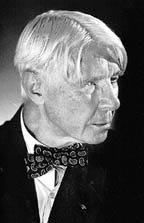
Carl Sandburg, Redux, Or, Happy Poetry Month!

While I was visiting at Sir Robin's place, he reminded us all that this is National Poetry Month. I knew this. I just didn't actually acknowledge it, not even when I was teaching poetry, not even when I invited a poet to visit my classroom next week. Talk about being too close to the trees to see the forest...


This made me think about The Official Poet of Bitty's Back Porch, Carl Sandburg. It's not every blog that has an Official Poet, I don't suppose, but this one does. Because I am One Busy Person, I'm going to honor NPM for now by rerunning a Sandburg post. I've never rerun anything before, but Law & Order does it to great effect, so why not me, too? Here goes, from March 31, 2006:

Some weeks back, I waxed, um, poetic about Carl Sandburg, favorite son of our mutual natal state, Illinois. At the time, I bemoaned the cost of the used Complete Poems of Carl Sandburg as out of my reach.

Well.

I found a less expensive copy.

Over the past five years -- and only AFTER finishing my formal education, I might add -- I've come to appreciate poetry. For years it intimidated me, but once I realized the obvious, that it is ok not to like or understand it all, just as it is ok not to like or understand all prose, poetry and I became good friends.

Poetry must be read slowly, carefully. If not, one might as well be reading the back of a Tylenol bottle.

And so, a week or so ago, slowly grazing in my new/old Sandburg book, I confirmed two things:

(1) Lefties, Carl is for sure one of us.
(2) I can get overstimulated quickly by poetry. Reading too much Sandburg produces the same dazed mental state in me as eating too much canned icing.

I offer two Sandburg poems today because one just isn't enough. The first is a prose poem that shows us two things: although he worked mostly in traditional forms, Sandburg wasn't a slave to tradition. Secondly, plus ça change, plus c’est la même chose.

From Good Morning, America (originally copyrighted in 1928):

Implications

When the charge of election bribery was brought against an Illinois senator, he replied, "I read the Bible and believe it from cover to cover."

When his accusers specified five hundred dollars of corruption money was paid in a St. Louis hotel bathroom, his friends answered, "He is faithful to his wife and always kind to his children."

When he was ousted from the national senate and the doors of his bank were closed by government receivers and a grand jury indicted him, he took the vows of an old established church.

When a jury acquitted him of guilt as a bank wrecker, following the testimony of prominent citizens that he was an honest man, he issued a statement to the public for the newspapers, proclaiming he knew beforehand no jury would darken the future of an honest man with an unjust verdict.

The second poem, also from Good Morning, America, I'm rather certain I've read before, long ago:

Money, Politics, Love and Glory

Who put up that cage?
Who hung it up with bars, doors?
Why do those on the inside want to get out?
Why do those outside want to get in?
What is this crying inside and out all the time?
What is this endless, useless beating of baffled wings at these bars, doors, this cage?

Monday, February 04, 2008

My Inner Prufrock

I didn't see this coming, although I have to sorta kinda agree with the narrative that justifies this choice -- especially about the "hopeless effort of people trying to impress other people..."

I guess I should go back and read that poem that most people despise.


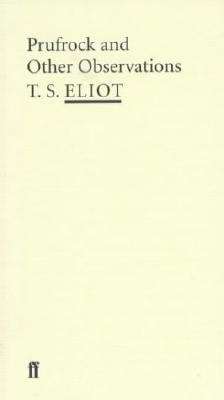
You're Prufrock and Other Observations!

by T.S. Eliot

Though you are very short and often overshadowed, your voice is poetic
and lyrical. Dark and brooding, you see the world as a hopeless effort of people trying
to impress other people. Though you make reference to almost everything, you've really
heard enough about Michelangelo. You measure out your life with coffee spoons.


Take the Book Quiz
at the Blue Pyramid.


Hat tip to Melissa, whom I am not trying to impress. ;)